Mdina vs Tarxien
Side-by-side comparison of property prices, lifestyle, and practical info to help you choose the right area.
Summary
Tarxien is better for families and budget buyers seeking affordable residential living with strong transport links, while Mdina suits culture lovers and tourists drawn to car-free heritage living in a medieval fortress. Tarxien offers family ratings of 7/10 and transport scores of 8/10, with townhouses often under €200,000 and a 10-minute drive to the airport. Mdina rates 10/10 for safety and 7/10 for dining, but the car-free citadel holds fewer than 300 residents and heritage properties command premium prices.
The two towns sit roughly 10 km apart. Tarxien connects to Valletta via bus routes 2, 3, 4, and 6 in about 15 minutes, while Mdina relies on routes 51 and 52 from the Rabat interchange. Tarxien provides walkable daily amenities and an authentic local community, whereas Mdina residents depend on adjacent Rabat for shopping and park outside the city gates.
Tarxien appeals to families wanting urban convenience at low cost, with UNESCO-listed prehistoric temples on the doorstep. Mdina attracts buyers prepared for strict conservation rules and limited amenities in exchange for panoramic bastion views and 8,000 years of documented history.
Living in Mdina
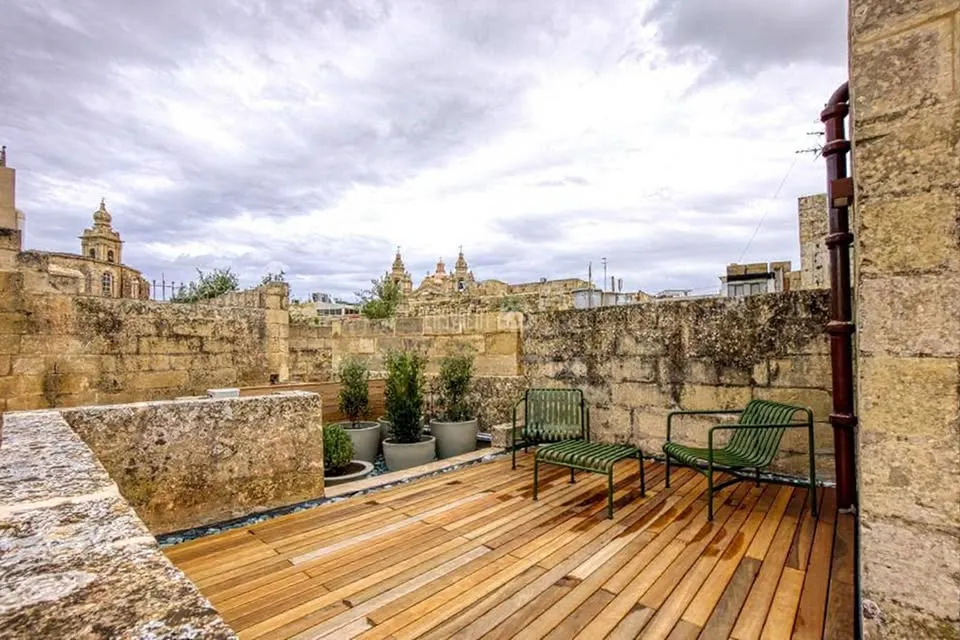
Mdina is the Silent City — a walled medieval citadel on a hilltop in central Malta where cars are banned, tourists whisper, and the only sound is the click of footsteps on golden limestone. Home to fewer than 300 residents, it is one of Europe's smallest inhabited cities and arguably its most atmospheric. The city's history predates the Knights of St. John by centuries. Originally a Phoenician settlement, then a Roman city, then the Arab capital of Malta, Mdina has layer upon layer of history compressed into its tiny footprint. The narrow streets are deliberately non-linear — a defensive trick to confuse invaders, now a maze that delights visitors. Palaces line every alley, many still privately owned by Maltese noble families who've held them for generations. Property in Mdina is rare and tightly regulated. The few apartments and townhouses that come up for sale are heritage-listed, requiring strict adherence to conservation rules. Buyers are getting a piece of history — original stone arches, tiled floors, and walls thick enough to withstand cannon fire. It's not for everyone: no parking, limited amenities, and constant tourist foot traffic. But for a small number of buyers, the chance to live in an 8,000-year-old fortress city is worth every restriction.
Highlights
- Cars banned — one of Europe's few car-free cities
- Fewer than 300 residents in an 8,000-year-old city
- St. Paul's Cathedral — baroque masterpiece
- Panoramic views from the city bastions
- Featured as King's Landing in Game of Thrones Season 1
Living in Tarxien
Tarxien is a small town in Malta's south that punches well above its weight in historical significance. The Tarxien Temples — a UNESCO World Heritage Site sitting in the middle of a residential neighbourhood — are among the oldest freestanding stone structures on Earth, predating the Egyptian pyramids by over a thousand years. The temples feature intricate stone carvings of animals and spiral patterns that have become symbols of Malta's ancient heritage. The town itself is a typical southern Maltese residential area — modest townhouses, apartment blocks, and a parish church dedicated to the Annunciation. The Hypogeum of Hal Saflieni, an underground necropolis carved from solid rock around 3000 BC, sits just outside Tarxien's boundary and is one of the most extraordinary archaeological sites in the world. Tickets to visit it sell out months in advance. Property in Tarxien is among the most affordable in urban Malta. It's a no-frills residential area with good connections to Paola, the Three Cities, and Valletta. The appeal is purely practical — low prices, decent location, daily amenities on the doorstep. The ancient temples in the back garden are a bonus.
Highlights
- Tarxien Temples — older than the Egyptian pyramids
- Hal Saflieni Hypogeum nearby — underground ancient necropolis
- Among the most affordable property in urban Malta
- Good connections to Paola and the Three Cities
- Authentic southern Maltese residential life
Lifestyle Comparison
Which Area Is Right For You?
Choose Mdina
Mdina comes out ahead in dining, safety .
Choose Tarxien
Tarxien comes out ahead in family, beaches, transport .